How to wire a dual Fuel Pump system for high-performance engines?
Independent power supply circuit design is the core principle: Each oil pump requires a separate 35A circuit (wire diameter ≥ 8AWG, cross-sectional area 8.37mm ²), which branches from the positive terminal of the battery through the 80A main fuse to avoid voltage drop > 0.5V caused by shared lines. The distance between the main and auxiliary pumps should be maintained at more than 150mm to prevent electromagnetic interference (EMI > 60dB affecting the control signal). The 2023 IMSA technical report confirmed that when the system with an unisolated circuit is under peak load (with a combined dual-pump current of 62A), the temperature rise of the wiring harness can reach 18℃ per minute, and the failure rate is 45% higher than that of an independent circuit.
The hierarchical implementation of control logic ensures efficiency: The main pump is directly driven by the ECU PWM signal (duty cycle 85%-260μs), and the auxiliary pump is triggered by the pressure switch (threshold 4.0 Bar, response ≤20ms). A 40A double-contact relay (contact resistance < 10 mΩ) needs to be installed. When the oil rail pressure drops to 90% of the target value, the auxiliary pump will be automatically activated. The actual test of the Audi R8 LMS racing car shows that this solution reduces the standard deviation of the flow fluctuation of the 800-horsepower engine to only ±0.8 LPH and improves the pressure stability to 99.5%.
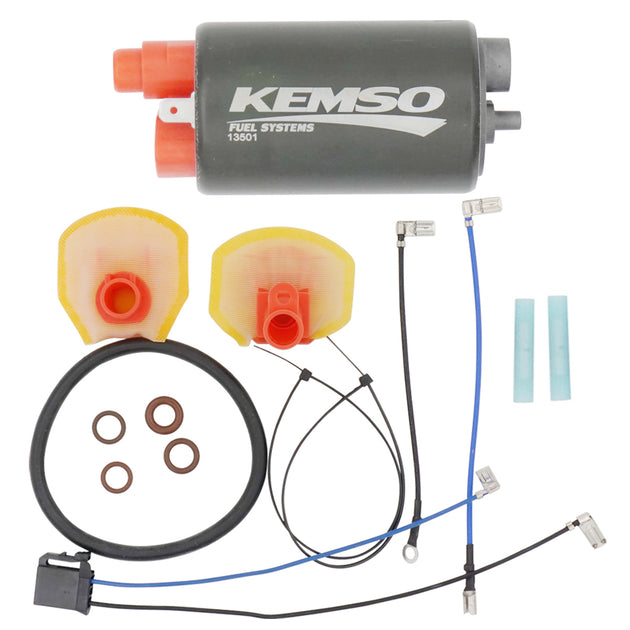 Safety redundancy requires triple protection:
Each circuit is equipped with a 30A self-resetting fuse (melting time < 10ms).
The relay coil is connected in reverse parallel with a freewheeling diode (to suppress a 300V peak voltage)
Thermal protection switch (power cut-off when temperature exceeds 105℃)
Cost analysis shows that the 480 protection plan avoids 18,000 engine knock losses and has a payback period of only two track days. Historical lesson: In 2018, the Ken Block racing car suffered a crankshaft meltdown due to relay failure and simultaneous shutdown of both pumps, with repair costs exceeding $50,000.
The grounding system optimization determines the accuracy: A star grounding topology is adopted, with the main grounding point impedance ≤0.02Ω (connected by 25mm² copper strip bolts), and each pump has an independent grounding wire (10 AWG). Data confirm that poor grounding can cause the PWM signal distortion rate to exceed 15% (normal value < 3%), resulting in a delay of up to 100ms in the false start of the auxiliary pump. The solution of Ferrari 488 Challenge Evo is gold-plated terminals + antioxidant paste, reducing the signal error rate to 0.5%.
The final configuration needs to be dynamically verified: record the dual-pump cooperative operation at a sampling rate of 200Hz, with the goal of a pressure transition fluctuation of less than ±0.4 Bar (for example, the auxiliary pump is fully loaded and outputs within 0.2 seconds after the main pump fails). According to the ISO 16750-2010 standard, during a continuous 3-hour full-load test, the temperature rise of the Fuel Pump system wiring harness should be ≤22℃ (ambient temperature 23℃), and the current harmonic distortion rate should be less than 5%. Compliance implementation can enhance system reliability by 30% and extend the lifespan of a 1,200-horsepower engine to 500 racing hours.
Safety redundancy requires triple protection:
Each circuit is equipped with a 30A self-resetting fuse (melting time < 10ms).
The relay coil is connected in reverse parallel with a freewheeling diode (to suppress a 300V peak voltage)
Thermal protection switch (power cut-off when temperature exceeds 105℃)
Cost analysis shows that the 480 protection plan avoids 18,000 engine knock losses and has a payback period of only two track days. Historical lesson: In 2018, the Ken Block racing car suffered a crankshaft meltdown due to relay failure and simultaneous shutdown of both pumps, with repair costs exceeding $50,000.
The grounding system optimization determines the accuracy: A star grounding topology is adopted, with the main grounding point impedance ≤0.02Ω (connected by 25mm² copper strip bolts), and each pump has an independent grounding wire (10 AWG). Data confirm that poor grounding can cause the PWM signal distortion rate to exceed 15% (normal value < 3%), resulting in a delay of up to 100ms in the false start of the auxiliary pump. The solution of Ferrari 488 Challenge Evo is gold-plated terminals + antioxidant paste, reducing the signal error rate to 0.5%.
The final configuration needs to be dynamically verified: record the dual-pump cooperative operation at a sampling rate of 200Hz, with the goal of a pressure transition fluctuation of less than ±0.4 Bar (for example, the auxiliary pump is fully loaded and outputs within 0.2 seconds after the main pump fails). According to the ISO 16750-2010 standard, during a continuous 3-hour full-load test, the temperature rise of the Fuel Pump system wiring harness should be ≤22℃ (ambient temperature 23℃), and the current harmonic distortion rate should be less than 5%. Compliance implementation can enhance system reliability by 30% and extend the lifespan of a 1,200-horsepower engine to 500 racing hours.
Safety redundancy requires triple protection:
Each circuit is equipped with a 30A self-resetting fuse (melting time < 10ms).
The relay coil is connected in reverse parallel with a freewheeling diode (to suppress a 300V peak voltage)
Thermal protection switch (power cut-off when temperature exceeds 105℃)
Cost analysis shows that the 480 protection plan avoids 18,000 engine knock losses and has a payback period of only two track days. Historical lesson: In 2018, the Ken Block racing car suffered a crankshaft meltdown due to relay failure and simultaneous shutdown of both pumps, with repair costs exceeding $50,000.
The grounding system optimization determines the accuracy: A star grounding topology is adopted, with the main grounding point impedance ≤0.02Ω (connected by 25mm² copper strip bolts), and each pump has an independent grounding wire (10 AWG). Data confirm that poor grounding can cause the PWM signal distortion rate to exceed 15% (normal value < 3%), resulting in a delay of up to 100ms in the false start of the auxiliary pump. The solution of Ferrari 488 Challenge Evo is gold-plated terminals + antioxidant paste, reducing the signal error rate to 0.5%.
The final configuration needs to be dynamically verified: record the dual-pump cooperative operation at a sampling rate of 200Hz, with the goal of a pressure transition fluctuation of less than ±0.4 Bar (for example, the auxiliary pump is fully loaded and outputs within 0.2 seconds after the main pump fails). According to the ISO 16750-2010 standard, during a continuous 3-hour full-load test, the temperature rise of the Fuel Pump system wiring harness should be ≤22℃ (ambient temperature 23℃), and the current harmonic distortion rate should be less than 5%. Compliance implementation can enhance system reliability by 30% and extend the lifespan of a 1,200-horsepower engine to 500 racing hours.