Price Quietly Omits MOQ, Lead Time and Freight: What to Ask
A cost figure is only useful once it names a cross-section, a standard and a delivery point, and the manufacturer's own pages stop short of that. KUKA CABLE publishes no unit price, no per-metre figure, no minimum order, no lead time and no freight cost, and says nothing about warranty terms. What the site does publish is the technical table that makes two quotations comparable, beginning with 4 mm² at a 5.5 mm nominal diameter and a 59 g/m nominal weight.

Key takeaways
- No unit price, no per-metre figure, no MOQ, no lead time, no shipping cost and no warranty terms are published anywhere on the site.
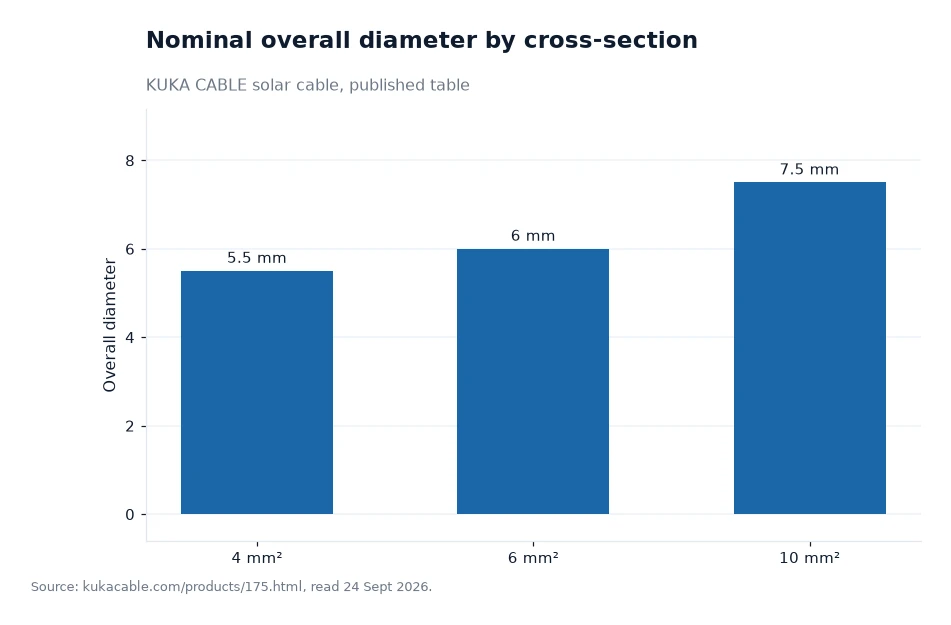
- Published instead: nominal diameter 5.5 mm, 6.0 mm and 7.5 mm, and nominal weight 59 g/m, 78 g/m and 130 g/m for 4 mm², 6 mm² and 10 mm².
- Free samples are offered on product pages, and data sheets and the company catalogue can be downloaded.
- A one-stop butler service is described, with a product consultant responsible from enquiry through delivery to post-maintenance.
What the site actually publishes about cost
A buyer hunting for a solar cable price on the manufacturer's pages will not find one, and that absence is deliberate rather than accidental: the published pages are technical, and the commercial terms live in the enquiry. The pattern is consistent across the product pages, the service page and the logistics page — specifications, tests, certificates and service descriptions, with cost left out.
What replaces it is a set of numbers that decide whether two offers are for the same thing. The solar cable section gives the conductor construction, the nominal overall diameter and the nominal weight for each cross-section, with 4 mm² built from 56 strands of 0.29 mm, a 5.5 mm diameter and 59 g/m. Those three values are the first filter on any quotation.
The lines a quotation has to state
Five items turn a price into a comparison, and the site's own published data makes the list short and checkable.
- The cross-section and the standard: the 1500 V build carries TUV 2PfG 1169/08.2007, EN 50618:2014 and IEC 62930, and a quote that names none of them is a different cable.
- The nominal diameter and weight for that section, so the delivered reel can be checked against the datasheet.
- The order quantity and whether mixed lengths in one order count towards it.
- The shipping location and the freight basis: the company page lists Manchester, Logroño, Tangerang and Australian offices or warehouses alongside Shanghai.
- The test record and batch reference, since 100% inspection and retained samples are published parts of the quality framework, and the published test list names the checks those samples answer to.
Comparing two offers on the same cable
Two quotations can only be compared once both name a build. A 4 mm² cable at 5.5 mm and 59 g/m and a 6 mm² cable at 6.0 mm and 78 g/m are different products, and a per-metre figure quoted without the section is not a price for anything in particular.
The published weights also give a check that does not depend on the seller's arithmetic. Weigh the drum on arrival and compare it with the length times the published weight; the author's own expectation for 500 m of 4 mm² is 59 × 500 = 29,500 g, or 29.5 kg of cable before the drum itself.
Minimum order, lead time and freight: the three silent items
The site publishes none of the three. There is no minimum order quantity, no lead time and no shipping cost anywhere on the pages, and no delivery commitment of any kind, so a schedule built on an assumption about them is a schedule built on nothing.
Each has a better question attached. For quantity: what is the smallest order the factory will run, and does it change by cross-section. For time: how long from order confirmation to dispatch from the named location. For freight: what is included in the quoted figure, and at which point the risk transfers.
Samples, data sheets and the catalogue
The published service material is more generous than the commercial material. Free samples are offered on product pages, which is a practical way to check the sheath print, the colour and the flexibility of a build before ordering a project quantity. Data sheets and the company catalogue can be downloaded.
The site also describes customised services and a logistics page, and a one-stop butler service in which a single product consultant carries the enquiry from first question through delivery to post-maintenance. None of those pages states a cost, so they set the scope of what can be asked for rather than the terms it will be offered on.
How to write the enquiry
Put the specification first. Name the cross-section, the number of cores, the colour, the standard the project requires and the destination city. Then ask the three silent questions in the same message: minimum order, lead time and freight basis, with the shipping location named.
Ask for the batch test record and for the diameter and weight to be confirmed against the datasheet before the order is placed. A supplier that answers all of that in writing has given a comparison a fair basis; one that answers only the cost has left the cable undefined.
| Item | Published on the manufacturer's site? | What to ask for |
|---|---|---|
| Unit price per metre | No | A figure tied to a named cross-section, standard and quantity |
| Minimum order quantity | No | The smallest run, and whether mixed lengths count towards it |
| Lead time | No | Time from order confirmation to dispatch, from a named location |
| Freight and terms | No | What the figure includes and where risk transfers |
| Nominal overall diameter | Yes: 5.5 mm at 4 mm² | Confirmation that the reel label matches the datasheet |
| Nominal weight | Yes: 59 g/m at 4 mm² | The drum length and the expected total weight |
Worked example
Convert a comparison into published units. The 6 mm² build is 78 g/m against 59 g/m for 4 mm², so 78 ÷ 59 = 1.32: about 32% more weight for every metre, which the author works out from the published table. Both figures include the same published 0.7 mm of insulation and 0.8 mm of sheath, so most of that extra mass is copper, though the site does not publish a copper-only weight.
Apply it to a delivery. A 1,000 m order in 4 mm² works out at 59 × 1,000 = 59,000 g, or 59 kg of cable, and the same length in 6 mm² at 78 × 1,000 = 78,000 g, or 78 kg, both the author's arithmetic on published figures. Those weights, not the cost line, are what a receiver can verify on the pallet with a scale.
Frequently asked questions
Why is there no price, MOQ or lead time on the website?
None of those items is published: the site carries no unit price, no per-metre figure, no minimum order quantity, no lead time and no shipping cost, and it states no warranty terms either. What it publishes instead is the technical data, including the cross-section table, the proof tests and the certificates, so a quotation has to be requested with the specification attached.
What should a quotation include so two offers can be compared?
Five lines make a comparison possible: the cross-section and the standard, the nominal diameter and weight for that section, the order quantity and how mixed lengths are counted, the shipping location and freight basis, and the test record or batch reference. The site publishes the standards TUV 2PfG 1169/08.2007, EN 50618:2014 and IEC 62930 for the 1500 V build, so a quote should name the same.
What to do before the order is placed
Send one message with the specification, the quantity, the destination and the three commercial questions, and ask for the answer in writing rather than by phone. Then check the reply against the published table: conductor construction, nominal diameter and nominal weight for the section, plus the standard the cable is printed with. Ask for a free sample if the build is new to the project, and keep the batch reference with the delivery papers. Cost, minimum order, lead time and freight are not on the site, so the enquiry is the only place those can come from.
Published diameters and weights quoted above were read off the manufacturer's own website, 24 Sept 2026[1].