How a Supplier Refuses a Question Is Its Own Decision Framework
Suppliers rarely refuse a question outright. They answer it in a different tense, attach a condition, price it separately, or explain why the question belongs to a later stage. Those four responses are not evasions; each one marks a real boundary in the supplier's model, and reading which boundary you have hit is the fastest way to build a decision framework. An established beauty brand that can categorise refusals this way stops arguing about impressions and starts comparing suppliers on where their limits sit. This article sets out the four categories, the signal each carries, and the decision that follows.
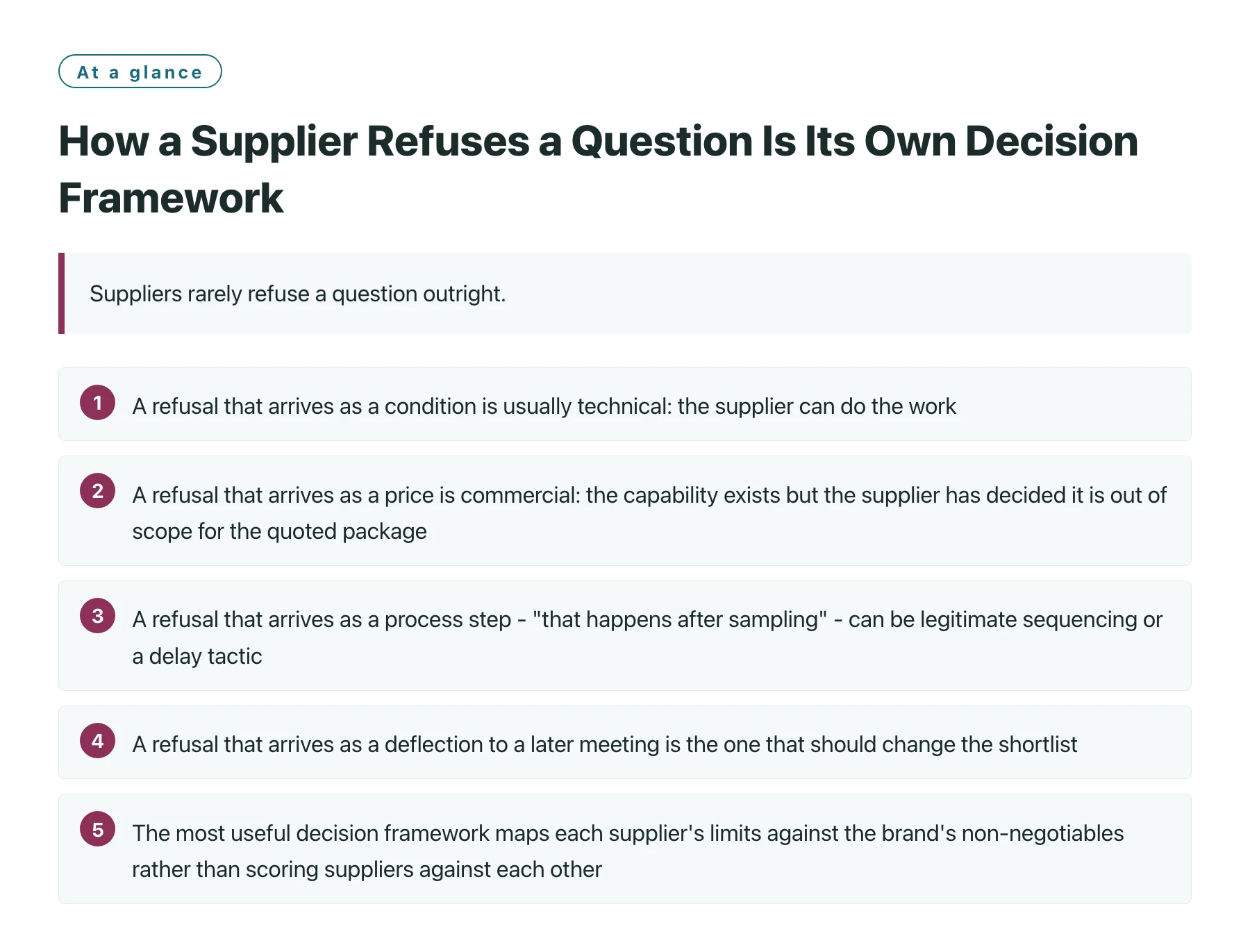
Key takeawaysA refusal that arrives as a condition is usually technical: the supplier can do the work, but only within a constraint it already knows about, such as a minimum batch or a material it cannot source reliably. · A refusal that arrives as a price is commercial: the capability exists but the supplier has decided it is out of scope for the quoted package, which is the most negotiable category of the four. [1] · A refusal that arrives as a process step - "that happens after sampling" - can be legitimate sequencing or a delay tactic, and the test is whether the supplier can still describe what will have to be true at that step. · A refusal that arrives as a deflection to a later meeting is the one that should change the shortlist, because it means the supplier cannot answer now and is unwilling to say so. · The most useful decision framework maps each supplier's limits against the brand's non-negotiables rather than scoring suppliers against each other, because a limit that matters for one product line may be irrelevant for another. · Write down what you asked, what came back, and which category it fell into; that log turns the shortlist meeting into a comparison of constraints instead of a re-run of the sales pitch.
Most guidance on choosing a fragrance manufacturer assumes suppliers answer questions and buyers evaluate answers. In practice, the more informative moment is when a question is not answered directly, and most buying teams have no shared language for what that moment means.
This framework is written for sourcing and product leads at established beauty brands who have already run a few supplier processes and want the shortlist meeting to produce a decision rather than another round of impressions.
Why the decision framework should be built from limits, not scores
Scorecards compare suppliers on common criteria and average away the differences that actually decide a project. A supplier that is excellent on five criteria and cannot do one non-negotiable thing will still score well, and the average hides the disqualifier.
A limits-based framework inverts that. List the six or eight things that cannot be traded - a dosage range, a filling format, a market, a volume, a lead time - then record, for each supplier, whether that item is inside or outside its model. The result is not a ranking but a set of viable combinations, which is what a project plan actually needs.
Refusals are how suppliers reveal those limits before a contract makes them expensive. That is why the wording of a refusal deserves more attention than the wording of a promise.
Four kinds of refusal and what each one means
| How the answer arrives | What it usually signals | Decision to take |
|---|---|---|
| "We can, but only above a minimum batch" | A real capacity or changeover constraint | Model the cost at that volume before dropping the supplier |
| "That would be a separate line item" | Capability exists outside the quoted scope | Ask for the price, then compare total scope rather than unit price [1] |
| "That is handled after sampling" | Sequencing, or a step the supplier has not planned | Ask what must be true at that step; an inability to describe it is the signal |
| "We can discuss that at the next meeting" | The supplier cannot answer now | Escalate once in writing; if it persists, treat the limit as real |
| "Our partner handles that" | Subcontracted process with a handover point | Identify the partner, the site and who owns the batch record |
| "That is not how the industry does it" | A genuine convention, or a supplier protecting a habit | Ask which rule or standard applies; a standard can be checked |
Each row converts a vague discomfort into a specific question with a specific answer, and the answer is what belongs in the comparison rather than the impression left by the meeting.
Turning the table into a decision in one meeting
- Step 1 - List the non-negotiablesWrite down the six or eight items that cannot be traded in this project, with a number attached to each.
- Step 2 - Mark each supplier inside or outsideUse the refusal log rather than memory; the categories above make the marking mechanical.
- Step 3 - Price the constraints that can be pricedA minimum batch or a subcontracted step is a cost question, not a capability question, so bring the number back into the comparison.
- Step 4 - Name the residual itemIdentify what remains unknown and decide how it will be verified - a sample, an inspection, or a first-order review.
- Step 5 - Revisit after the first orderLimits move as the relationship develops; the framework should be updated, not filed away.
Bring a written version of your non-negotiables to the shortlist meeting and ask each supplier to mark them. A supplier that engages with the list, including the items it cannot meet, is doing technical work in the room. For a benchmark of how a manufacturer describes the sequence from formula to finished bottle, and therefore which stages it expects to be asked about, perfume manufacturing process is a useful reference point. When no supplier can meet a non-negotiable, the item itself is usually too tightly specified for the market.
What the framework should not be used for
It is not a scoring system, and it should not be used to rank suppliers the team already prefers. Its purpose is to surface a disqualifying limit early, while switching costs are still low.
It also should not be applied to commercial terms alone. Price, exclusivity and lead time are negotiable variables; a filling format or a market registration is not, and mixing the two categories makes every limit look like a bargaining position.
Finally, a refusal is not evidence of dishonesty. Manufacturers decline work for sound reasons, including reasons that protect the brand. [2] The question is whether the limit is compatible with your project, and that is answerable. More information about how a manufacturer describes its own process, and where the handover points sit, can be found by reading around the subject rather than by pushing the same question again. More information on the sequence is best gathered by comparing several suppliers' published descriptions side by side.
Sources
- SGS: Cosmetics, Personal Care & Household Testing —— Testing, inspection and certification services for cosmetics and personal care, including microbiological, stability and safety testing aligned with cosmetics GMP.
- Givaudan —— One of the largest fragrance and flavour houses; public material on fragrance creation, ingredient portfolio and market segments.
Frequently asked questions
What does it mean when a supplier will not answer a technical question directly?
It usually means the question sits outside the supplier's standard scope, not that the supplier is hiding something. Categorise the answer: a condition suggests a capacity limit, a price suggests a scope boundary, and a deferral to a later meeting suggests the supplier cannot answer now. Each category calls for a different follow-up.
Should a refusal ever disqualify a supplier?
Only when the refused item is a non-negotiable for your project and remains outside the supplier's model after one written escalation. A refusal on a negotiable item, such as price or volume, is a commercial discussion rather than a disqualifier.
How do we compare suppliers when each one refuses a different thing?
Compare them on your non-negotiables rather than against each other. Mark each supplier inside or outside for each item, price the constraints that can be priced, and name what remains unverified. The result is a set of viable options rather than a ranking.
Is it a red flag when a supplier says a partner handles part of the process?
Not by itself, since subcontracting filling, decoration or testing is normal. The red flag is a vague answer about the partner: ask for the site, the process step it owns, and who holds the batch record and the release signature.
How often should the decision framework be revisited?
After every first order and whenever the product line changes market or format. Manufacturing limits are not permanent, and a constraint that made a supplier unsuitable for one product may be irrelevant for the next.